Room by Room · 2026 Visitor Guide
57 rooms across four floors — royal apartments, a genuine dungeon, a secret staircase, and Queen Marie's private garden. Here's what to see, what to skip, and how long each area actually takes.
Bran Castle is a self-guided museum spread across four floors connected by narrow stone staircases. Most of what you see are the original rooms from Queen Marie of Romania's tenure (1920–1938) — furnished with period pieces, royal portraits, medieval weapons, and her personal collection of religious icons. The visit flows in a set one-way route so you won't get lost. Highlights include the Royal Apartments, the dungeon, the secret staircase inside the castle well, and the open courtyard with views across the Transylvanian landscape. The Time Tunnel (an extra-cost multimedia elevator) is entirely skippable.
Ranked by how impressed visitors typically are — not by the order you'll encounter them.
Concealed inside the old castle well in the central courtyard, this narrow stone staircase connects multiple floors and was likely used during sieges to move the garrison unseen. It's the one feature visitors consistently describe as the most atmospheric moment of the visit — stepping into the well shaft and realising there's an entire hidden passage inside. A guide adds context, but the staircase speaks for itself even without one.
The most historically rich rooms in the castle. Queen Marie transformed Bran from a decaying garrison into an elegant summer residence, and her personal rooms survive largely intact — carved wooden furniture, Byzantine icons, royal portraits, and her writing desk. The story of her reign, her love for Romania, and the tragic dispersal of her heart after death is genuinely moving.
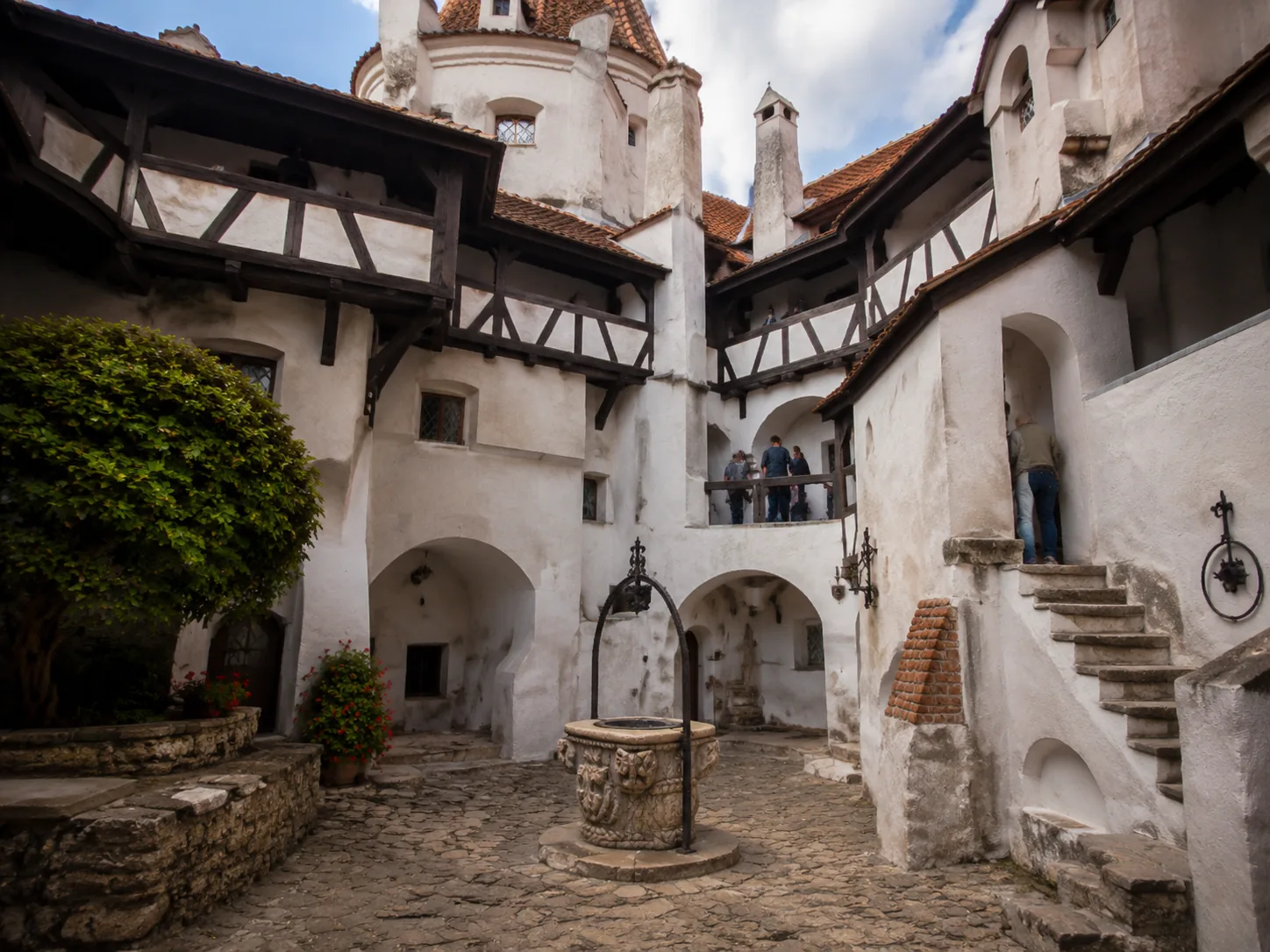
The heart of the castle — an open stone courtyard surrounded by the four castle towers, with the ancient well at its centre. This is where the secret staircase entrance is located, and where you get the best views upward to the battlements. On clear days the mountain backdrop is spectacular.
Bran's grandest ceremonial space — a high-ceilinged hall with the royal throne at its centre, medieval tapestries on the walls, and period weaponry on display. Not enormous by palace standards, but deeply atmospheric with the original carved woodwork and the imposing carved throne that Queen Marie commissioned for state ceremonies.
An authentic medieval holding area below the main castle levels, with original stone cells, iron fixtures, and displays of period restraint devices. This is the section that most fully earns the Dracula atmosphere visitors are hoping for — dark, cold, and genuinely unsettling. Not recommended for young children or those sensitive to this kind of display.
Throughout the castle rooms you'll find displays of medieval weapons (swords, halberds, armour), Queen Marie's personal icon collection, royal correspondence, and period furniture sourced from across Romania. English-language labels throughout explain each item's history. Allow extra time if you're interested in Romanian royal history — there's more here than most visitors realise.
A modern multimedia elevator installed inside the castle well shaft. Costs an extra ~20 RON (~$4.50) on top of your standard ticket. Lasts about 60 seconds. Animated screens play scenes from Bran's history as you descend. Most visitors describe it as a theme-park gimmick that adds little to the experience. The secret staircase — free with your ticket — is far more atmospheric.
The visit follows a fixed one-way path through the castle. You can't get lost — just follow the flow of other visitors. Here's what the sequence looks like.
The castle operates a strictly one-way visitor flow — you cannot go back. If you miss something you'll need to join the queue again from the entrance. Slow down in the apartments; most people rush this section and regret it.
Bran Castle has many narrow staircases and uneven stone floors. It is not wheelchair accessible. The castle involves significant climbing — wear flat, non-slip shoes. The dungeon in particular has low ceilings and very steep descents.
Small things that make a real difference to your experience inside the castle.
You can photograph everything inside the castle including the rooms, furniture, and courtyard. No flash in the darker rooms. The courtyard is the best spot for an exterior shot of the towers. Don't miss the view back toward the mountains from the upper battlements.
There is no food or drink available inside the castle. There are food stalls, chimney cake vendors, and a handful of restaurants in the village below at the foot of the hill. Have lunch before arriving or plan for a stop afterward — the visit runs 1 to 1.5 hours without refreshment breaks.
The secret staircase entrance is inside the castle well in the central courtyard. It's easy to walk past without realising what you're looking at. Look for the wooden door set into the well shaft — that's the entrance. Step inside and you'll find narrow stone steps winding between floors.
The castle is busiest between 11 AM and 3 PM, especially on summer weekends. Arrive at opening (9 AM) or after 4 PM for a noticeably quieter experience. The narrow staircases create bottlenecks when the castle is busy — earlier arrivals move through much more freely. See our crowd guide for full timing advice.
Most of what you see inside Bran Castle has nothing to do with Dracula. It's the legacy of Queen Marie of Romania (1875–1938) — a British-born granddaughter of both Queen Victoria and Tsar Alexander II who became Romania's most beloved monarch. She received the castle as a gift from the citizens of Brașov in 1920 and spent nearly two decades transforming it into an elegant summer retreat filled with Byzantine art, Romanian folk pieces, and her own considerable personality.
Marie designed her private apartments herself, installed a garden that cascades down the hillside below the castle walls, and furnished the rooms with objects she collected from across Romania. She was an accomplished author, a skilled propagandist for Romania at the Paris Peace Conference, and a genuine force of personality. The castle reflects her taste throughout.
When she died in 1938, she requested that her heart be removed and buried separately — close to the castle she loved. Her heart, in a small silver box, was removed during communist rule and eventually transferred to Pelișor Castle in Sinaia. The castle was seized in 1948 and opened as a state museum in 1956.
The full history →
Bran Castle has around 57 rooms across four floors, and the visitor route takes you through approximately 30–35 of them. These include Queen Marie's personal apartments, the throne room, royal dining rooms, an equipped dungeon, the castle courtyard with the secret staircase, and collections of medieval weapons and royal furniture. The self-guided visit typically takes 1 to 1.5 hours at a comfortable pace.
Yes — and it's one of the best parts of the visit. The staircase is hidden inside the old castle well in the central courtyard. A wooden door set into the well shaft opens onto narrow stone steps that wind between several floors. It was likely used during sieges to allow the garrison to move unseen. It's entirely authentic and included with your standard ticket.
The dungeon space itself is real — original medieval stone cells below the main castle levels, with authentic iron fixtures. The displays of restraint and torture devices inside are period-appropriate for a European medieval fortress, though some were likely added later to enhance the effect. The atmosphere is genuinely cold and dark. Not suitable for young children or visitors sensitive to these themes.
The Time Tunnel is a modern multimedia elevator installed inside the castle well shaft. It costs an extra ~20 RON (~$4.50) on top of your standard ticket and lasts about 60 seconds. Animated screens play as you descend. Most visitors describe it as a theme-park gimmick. The secret staircase in the same well is free with your ticket and far more interesting. Our recommendation: skip the Time Tunnel and save the money for a chimney cake in the village below.
Most visitors spend 1 to 1.5 hours inside the castle on the standard self-guided route. Allow up to 2 hours if you want to read all the exhibit labels and linger in the apartments. The outdoor museum in the castle grounds (relocated traditional Romanian village buildings) adds an optional 30–45 minutes. If you're on a guided day trip from Bucharest, typically 1.5–2 hours is allocated at Bran before moving to the next stop.
Bran Castle is not wheelchair accessible. The visit involves many narrow stone staircases, steep descents, uneven medieval floors, and low doorways. Visitors with significant mobility limitations will not be able to complete the standard route. The courtyard can be accessed without climbing the internal stairs, but this covers only a small portion of the castle. Wear flat, non-slip footwear regardless of your mobility level.