Myth vs History · The Real Story
Bram Stoker never visited Romania. Vlad the Impaler almost certainly never lived here. So how did a 14th-century customs fortress become the most famous vampire stronghold on earth?
Historically, no. Mythologically, absolutely. Bram Stoker's 1897 novel Dracula was written entirely from library research in London — he never visited Romania. The fictional Count Dracula's castle was inspired by a description of an unnamed Transylvanian fortress, and Bran's dramatic silhouette was close enough for the association to stick. The historical figure Vlad the Impaler, whose epithet "Drăculea" inspired the character's name, ruled from Târgoviște and may have passed through Bran at most once. The "Dracula's Castle" label is largely a 20th-century tourist invention — but it drew the world's attention to a genuinely magnificent medieval fortress, and the castle itself more than repays the visit.
Vlad III (c. 1431–1476/77) was a prince of Wallachia, the medieval kingdom south of the Carpathian Mountains. He ruled during one of the most turbulent periods in Romanian history, as the Ottoman Empire pushed steadily northward and local lords changed allegiances to survive. Vlad's response to this instability was methodical and, by any measure, extreme: he executed enemies — and often citizens — by impalement on wooden stakes, earning a reputation that spread across Europe within his own lifetime.
His father, Vlad II, was inducted into the Order of the Dragon (Societas Draconistarum) in 1431 — a chivalric order founded by Holy Roman Emperor Sigismund to defend Christian Europe against the Ottomans. In Romanian, the word for dragon is drac, and Dracul — the father's title — means both dragon and devil depending on context. Vlad III, as his son, became Drăculea: son of Dracul.
Bram Stoker found this name in William Wilkinson's 1820 book An Account of the Principalities of Wallachia and Moldavia, which noted briefly that "Dracula" meant devil in the Wallachian language. Stoker had no particular interest in impalement or Romanian medieval history. He just needed a name that sounded appropriately sinister for his fictional Transylvanian count.
Vlad III ruled from Târgoviște, 130 km south of Bran Castle. His documented residences and courts were in Wallachia, not Transylvania — Bran Castle sat on the border between the two regions and was controlled by the Transylvanian Saxons, not by Wallachian princes.
Almost certainly not as a resident. The most plausible historical connection is a single documented event: in 1462, after Vlad was ousted from Wallachia by Ottoman-backed forces, he fled northward into Transylvania and was captured by Hungarian King Matthias Corvinus. Some historians believe he may have been briefly held at Bran Castle during this period — but evidence is thin, and his main imprisonment was at Visegrád Castle in Hungary, where he spent twelve years before returning to Wallachia.
He may also have used the Bran mountain pass during military campaigns against the Saxons of Brașov — there are records of raids in the region. But "passing through a mountain pass" is a far cry from "living in a gothic castle and sleeping in a coffin."
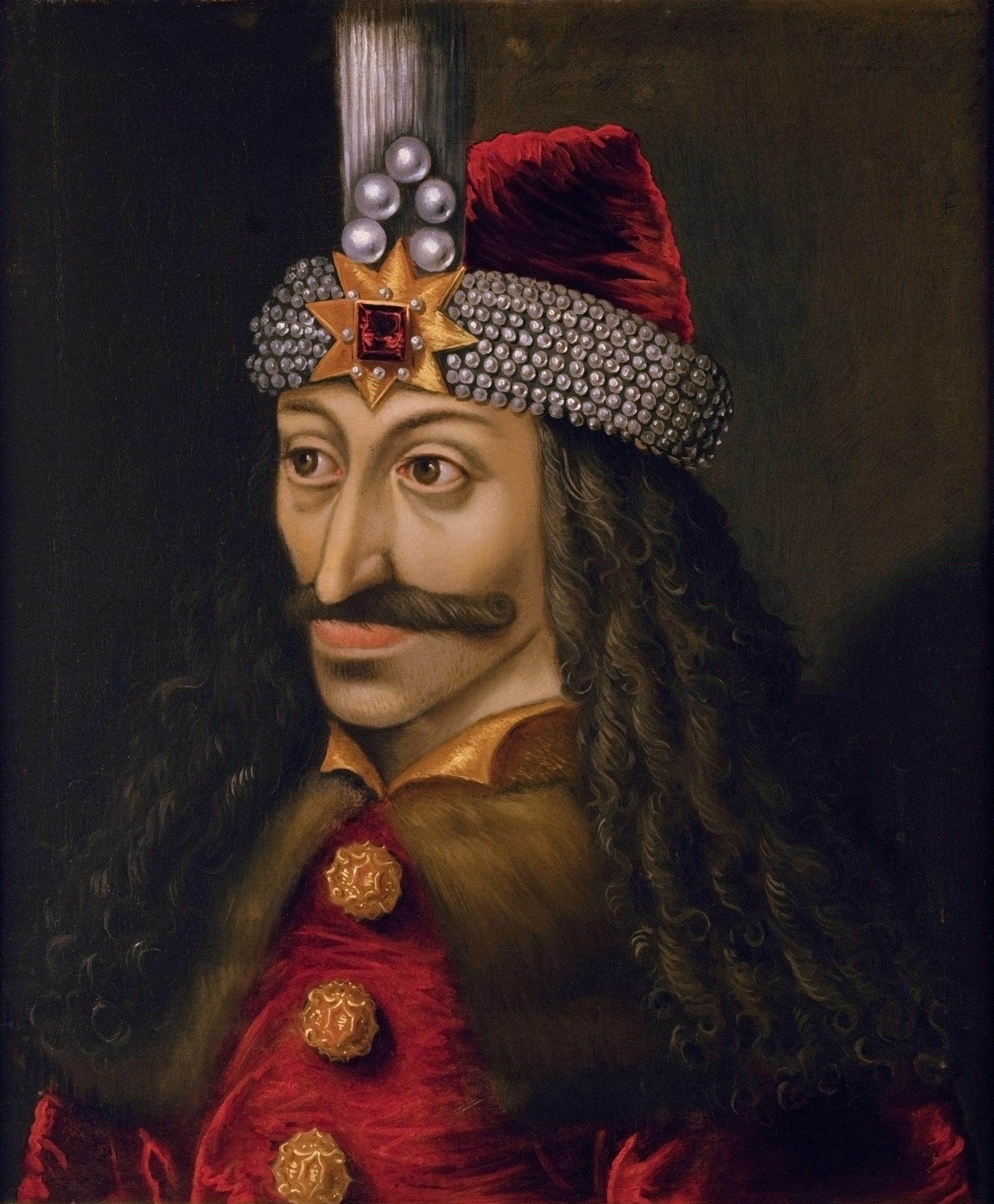
Vlad III "Drăculea" — the 15th-century Wallachian prince whose name Bram Stoker borrowed for his fictional vampire count. This portrait, likely a copy of an original from around 1462, now hangs in Ambras Castle, Austria.
Six hundred years from Saxon customs post to global vampire icon — the timeline of a legend that has almost nothing to do with the actual history.
What everyone thinks they know about Bran Castle and Dracula — and what the historical record actually shows.
This is perhaps the most persistent misconception. Vlad III ruled from Târgoviște, 130 km to the south. Bran was a Transylvanian Saxon customs post, not a Wallachian royal seat.
There is a possibility — not certainty — that Vlad passed through or was briefly detained at Bran after his 1462 defeat. His main imprisonment was at Visegrád Castle in Hungary.
Stoker never visited Romania and left no direct note linking his fictional castle to Bran specifically. His castle description was drawn from general Transylvanian imagery in his research books.
His fictional castle — hilltop, battlements, precipitous approaches, mountain setting — matches Bran closely. Whether coincidence or unconscious influence, the silhouette fits the myth.
It doesn't. "Dracula" (Drăculea) means "son of the dragon" or "son of the devil," referring to the Order of the Dragon that Vlad's father belonged to. Vampires are "strigoi" in Romanian folklore.
His methods — mass impalement of enemies and civilians alike, sometimes in the thousands — were documented by contemporaries across multiple countries. The historical reputation for cruelty is entirely real.
Stoker's primary source was Emily Gerard's 1888 The Land Beyond the Forest, which described Transylvanian vampire folklore in vivid detail. He also used William Wilkinson's 1820 history (where he found the name "Dracula"), a Hungarian atlas showing Bistrița and the Borgo Pass, and Charles Boner's 1865 Transylvania. He spent years in the reading room of the British Museum — never anywhere near Romania.
The Dracula myth brought the world's attention to Bran. The castle itself earns it.
Bran Castle is a real 14th-century fortification with real history. The towers, the battlements, the hidden staircase inside the castle well — these are authentic medieval construction, not a theme park recreation.
The real history of Bran — its transformation into Queen Marie of Romania's beloved summer retreat — is more remarkable than any vampire legend. Her personal apartments, her garden, and her own preserved heart (originally buried nearby) tell a story of royal loss and communist desecration that is genuinely moving.
Bran sits at the edge of the Bucegi Mountains, with dramatic forested slopes rising behind the castle walls. Even on a grey day, the landscape has exactly the gothic atmosphere you came for — fog, pine forests, and medieval stone towers.
Knowing that Stoker invented the Dracula connection from a library in London actually makes the experience richer. You're watching a living myth in action — a 19th-century novelist's imagination reshaping how the world sees an entire country. That is its own kind of remarkable.
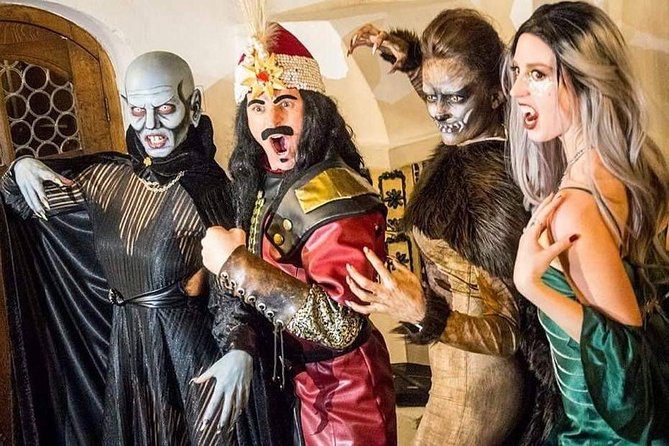
Every October 31st, Bran Castle hosts its annual Halloween party — the one night a year when the Dracula myth is fully, gloriously, and without apology embraced. The castle opens after dark, fills with period-costumed performers, theatrical lighting, and live music, and becomes exactly the gothic vampire stronghold the legend always promised.
Tickets sell out months in advance. If you're planning a Halloween visit to Romania, this is a bucket-list experience — whether or not Vlad the Impaler ever slept here. It's spectacular, theatrical, and exactly as over-the-top as the occasion demands.
Halloween tickets are sold separately from standard entry and typically go on sale in July–August. Day-trip tours from Bucharest specifically for Halloween are also available via GetYourGuide.
Not historically, but mythologically it is the closest thing that exists. Bram Stoker based his fictional Count Dracula on a name from a footnote in a 19th-century history book and set his castle in a generic Transylvanian landscape drawn from travel memoirs. The historical Vlad the Impaler ("Drăculea") had almost no confirmed connection to Bran Castle — his court was 130 km south in Wallachia. The "Dracula's Castle" label emerged gradually through 20th-century tourism marketing, not from Stoker's text or Romanian history.
Almost certainly not as a residence. Vlad III ruled from Târgoviște and later Bucharest. The one historical possibility is that he was briefly held at Bran in 1462 after being captured by Hungarian forces — but this is contested by historians, and his actual imprisonment was at Visegrád Castle in Hungary for twelve years. There are records of Vlad raiding Saxon settlements in the Brașov region, but that does not mean he occupied Bran Castle itself.
No. Bram Stoker never set foot in Romania. He wrote the novel entirely from the reading room of the British Museum in London, using travel memoirs, a Hungarian atlas, Transylvanian folklore collections, and a brief footnote about the name "Dracula" in William Wilkinson's 1820 Account of the Principalities of Wallachia and Moldavia. His primary source for Transylvanian atmosphere was Emily Gerard's 1888 book The Land Beyond the Forest.
Vlad III (c. 1431–1476/77) was a 15th-century prince of Wallachia who ruled during three separate periods amid intense Ottoman pressure. He is called "the Impaler" because of his documented practice of executing enemies — and civilians — on wooden stakes. His father, Vlad II, was inducted into the Order of the Dragon (Societas Draconistarum), earning the title "Dracul" (dragon/devil in Romanian). Vlad III inherited the suffix "-ea" meaning "son of," making him Drăculea — son of Dracul. Stoker found this name in a history book and adopted it for his vampire character.
Yes, unambiguously. The castle is a genuine 14th-century medieval fortress with authentic rooms, period furniture, hidden staircases, and the extraordinary story of Queen Marie of Romania who made it a royal summer retreat. The surrounding mountain scenery is dramatic. The history — separate from any vampire mythology — is compelling. And the legend itself, as a cultural phenomenon, is worth engaging with. You don't need Vlad to have been there for it to be a great visit.
Vlad's principal court was at Târgoviște, the capital of Wallachia at the time, roughly 130 km south of Bran. He also spent time at the court in Bucharest. His famous fortress, Poenari Castle — perched dramatically on a cliff above the Argeș River — is sometimes called the "true" castle of Vlad Dracula and was built partly by enslaved boyars as punishment. Poenari is a genuine ruin today, accessible via 1,480 stairs and about 100 km west of Bucharest.